The Localization Problem: How Western Publishers Are Doing to Anime What They Already Did to Gaming
Featured image property of its respective copyright owner. Used for review purposes only.
If you watched the AAA gaming industry collapse under the weight of its own editorial agenda and thought "at least anime is safe" — think again.
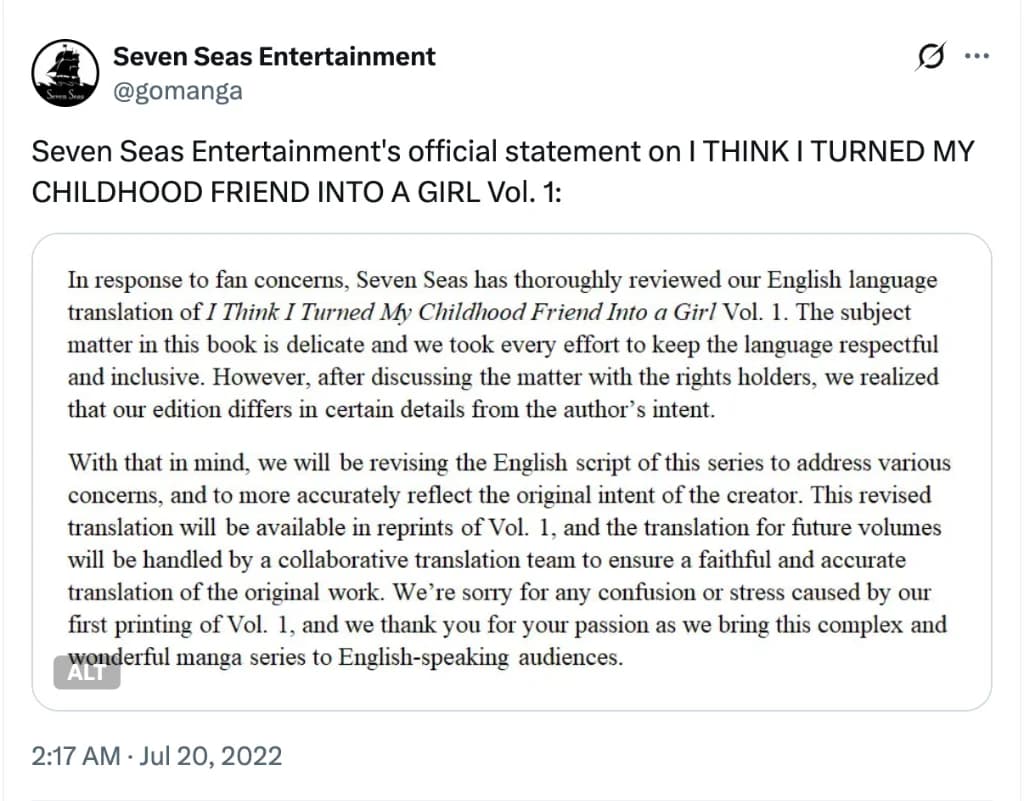
The Seven Seas Entertainment situation should have been a wake-up call. In 2022, the publisher released their English localization of I Think I Turned My Childhood Friend Into a Girl — a romance manga by mangaka Azusa Banjo — and quietly rewrote the story's crossdressing male love interest as a transgender woman. Not a translation error. Not a clumsy idiom choice. A deliberate editorial decision to change what the author wrote. When readers with Japanese literacy flagged it, fans went directly to Banjo herself. She confirmed it wasn't her intent. Seven Seas launched an investigation into their own release, apologized, and promised a revised translation more faithful to Banjo's original vision.
!I Think I Turned My Childhood Friend Into a Girl
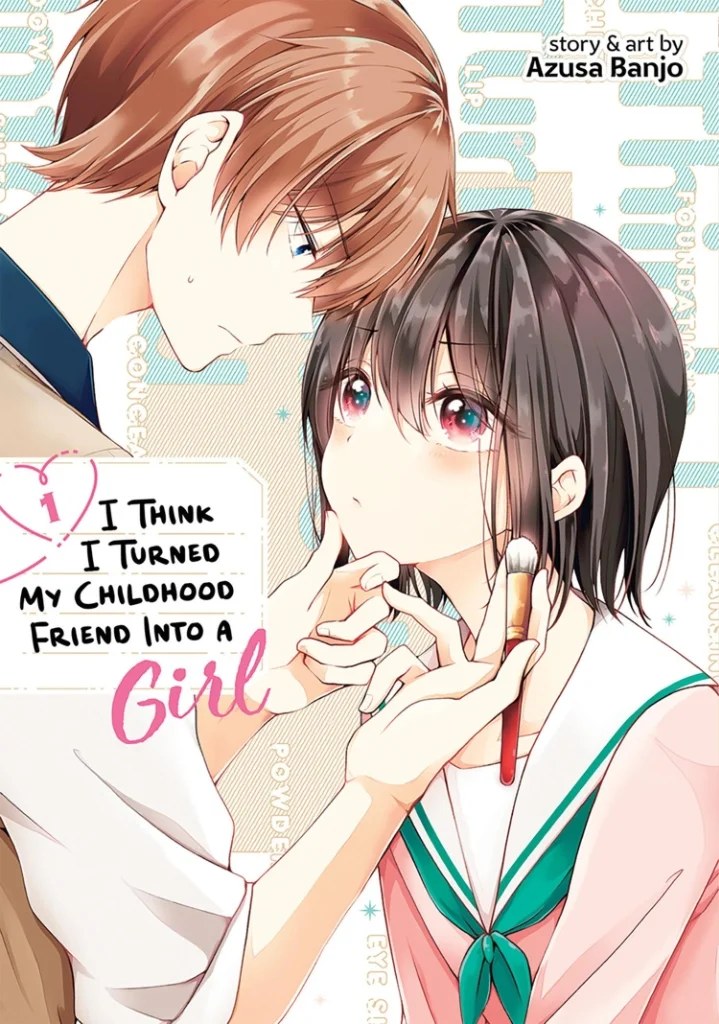
The damage was already done. And now, years later, with an anime adaptation announced, the very first conversation isn't about the story, the animation studio, or the director. It's about the mistranslation. That's the legacy Seven Seas left on a series they were supposed to be protecting.
This is what bad localization actually costs. Not a news cycle. A permanent stain on how a story enters the cultural conversation.
What Localization Is Supposed to Be
Localization, at its best, is a craft. It's the work of taking something built in one language, one cultural context, one set of references and idioms, and rebuilding it faithfully in another — so that a reader in a different country gets as close as possible to what the original audience experienced. It requires deep knowledge of both languages, genuine respect for the source material, and the discipline to leave your own preferences at the door.
The key word is faithfully. A translator's job is not to improve the story. It's not to update it, modernize it, or bring it into alignment with what they personally believe the author should have written. It's to serve the text. Full stop.
That sounds obvious. And for most of the history of manga and anime localization in the West, it mostly held. There were always liberties taken — 4Kids dubbing over rice balls as donuts, early Viz softening mature content — but these were commercial decisions made under specific constraints, not ideological rewrites. The intent was still to bring the work to a new audience, not to use the work as a vehicle for something else entirely.
That distinction has eroded. And the erosion is accelerating.
The Pattern
What Seven Seas did isn't an isolated incident. It's a pattern, and it's been documented enough times that calling it a trend is no longer hyperbole.
The mechanics are almost always the same. A localization team — often small, often ideologically homogeneous, operating with minimal oversight from the original Japanese rights holders — makes a series of editorial decisions that go well beyond translation. Pronouns get changed. Character motivations get reframed. Lines that don't exist in the Japanese get added. Lines that do exist get softened, removed, or inverted. The changes are usually subtle enough that a casual reader won't catch them — you'd need to compare the Japanese text directly. But they accumulate, and the cumulative effect is a story that has been quietly redirected toward conclusions the original author never intended.
When these changes get called out, the response from the localization community is almost always the same: accusations of bad faith from critics, defensive statements about "cultural adaptation," and occasionally, when the evidence is too overwhelming to deny, a quiet apology that does nothing to undo the years of misinformation already in circulation.
The Childhood Friend situation is a clean example of how this plays out. After the alterations were exposed, localizer Katrina Leonoudakis — a separate industry figure whose credits include Persona 5 Royal and Shin Megami Tensei V — stepped in to publicly defend the translator, stating they had "done their homework," read future volumes, and "consulted trans people" before making the changes. The implication being that ideological due diligence justifies overriding the author's intent. It doesn't. Consulting external advocates about what a story should say is not the same as translating what the author actually wrote. These are opposite activities.
And this wasn't even Seven Seas' first offense. The same publisher had already admitted to "heavy-handed" localization of Mushoku Tensei: Jobless Reincarnation and issued a separate apology for removing the protagonist's introspective questioning of her own feelings from I'm in Love With the Villainess — a girls' love manga where that self-reflection was core to the emotional premise. Three documented cases of editorial overreach from the same publisher. This is not a pattern of isolated mistakes. It's an institutional disposition.
The AAA Gaming Parallel Is Not an Accident
Anyone who followed the Western AAA gaming industry over the last decade watched this play out in slow motion and then all at once.
It started with discourse. Games journalists and critics began pushing the idea that games needed to "do better" — to represent more, to challenge more, to reflect a particular set of progressive values more explicitly. That discourse found its way into studios, initially at the margins and then increasingly at the center of development decisions. Character designs got revised late in production. Storylines got softened. Dialogue got rewritten in QA. Creative directors who pushed back found themselves isolated.
The games that came out of this process weren't just bad ideologically — they were often bad as games. The ideological agenda crowded out craft. When your character design is being iterated based on internal activist pressure rather than artistic vision, when your dialogue is being run through sensitivity readers who have no stake in whether the game is fun, the result is a product that satisfies no one and serves no one. The audience felt it. Sales reflected it. Some studios didn't survive the cycle.
The anime and manga industry is now being approached the same way, through the same entry point: localization and licensing. Western publishers hold the keys to the English-language market. Japanese studios and authors need them to reach that audience. And some of those publishers have decided that access comes with editorial conditions.
The difference is that manga and anime have something AAA gaming largely lost before it understood what was happening: a direct pipeline to the audience that bypasses the gatekeepers. Scanlations exist. Fan translations exist. Streaming platforms with subtitle options exist. The Japanese industry is also large enough and profitable enough domestically that it doesn't need Western publishers the way a Western studio needs Western publishers. That's the leverage point — and it matters.
The Author Is the Authority
This is the principle that gets lost in every one of these arguments, so it's worth stating plainly.
The author of a manga owns that story. Not the licensing company. Not the localization team. Not the distributor, the platform, or the English-language publisher. The author. Their intentions are not a secondary consideration to be weighed against what a translator thinks would be more progressive or more palatable or more marketable to a Western audience. They are the consideration. Everything else is in service of that.
When a localization company alters a character's identity, rewrites a relationship, or inserts thematic content that wasn't in the source, they are not adapting the work. They are replacing the author's work with their own and attaching the author's name to it. That is a betrayal of the author, a betrayal of the audience, and a betrayal of the basic purpose of the job they were hired to do.
The fact that this has become controversial — that arguing for author intent in a translation is now read by some as a political position — is itself a measure of how far the rot has spread.
What Happens If This Continues
The AAA gaming scenario is the template. If Western publishers continue to expand their footprint in the anime and manga licensing space without accountability for editorial fidelity, the trajectory is predictable.
The first casualty is trust. Audiences who have been burned by localization alterations stop trusting English releases. They seek out alternatives — fan translations, Japanese imports, raw chapter readers. The licensed product becomes the worse product, and the publisher's market position erodes from the inside.
The second casualty is the creative pipeline. As Western publishers gain more leverage — through exclusive deals, co-production arrangements, streaming exclusivity — the pressure on Japanese creators to pre-comply increases. Not every author will resist. Some will adapt their work preemptively to ensure Western distribution. The story that gets made will not be the story that would have been made without that pressure.
The third casualty is variety. The ideological lens that Western publishers bring to this process is not neutral and it is not broad. It tends to flatten. Stories that don't fit the frame get passed over, deprioritized, or quietly buried. The English-language audience ends up with a curated slice of what Japanese creators are actually making — a slice that reflects the preferences of a small group of intermediaries more than it reflects the actual output of the industry.
This is already happening in gaming. The Western market for Japanese games is thriving precisely because Japanese studios largely haven't bent to Western editorial pressure. From From Software to Capcom to Kojima Productions, the games that have broken through globally in the last decade are almost universally ones made without compromise to Western gatekeepers. The lesson is right there.
The Fix Is Simple. The Will Is the Problem.
None of this requires exotic solutions. The fix is straightforward: localization companies should translate what is written, not what they wish was written. Rights holders should audit English releases for fidelity. Contracts should include provisions that make unauthorized editorial alterations a breach. Audiences should have access to accurate information about what they're buying.
The will to enforce this is the problem. Japanese rights holders often lack the English-language resources to independently audit their own licensed releases. Western publishers know this and operate accordingly. The audience has to do the auditing themselves, which they increasingly are — which is why situations like Seven Seas become public, and why the pressure on publishers to do better is coming from readers with Japanese literacy, not from industry oversight.
That pressure needs to keep building. The moment the anime and manga industry becomes indistinguishable from the Western media ecosystem — the moment it becomes another venue for the same editorial agenda that has hollowed out film, television, and gaming — it loses the thing that made it worth localizing in the first place.
The Seven Seas situation is one data point. What makes it significant is not the incident itself but the pattern it sits inside. Western publishers are not passive conduits. Some of them are active participants in reshaping what Japanese creators make and how that work reaches global audiences. That reshaping is not neutral, it is not benign, and it is not what the audience signed up for.
The author wrote the story. The translator's job is to carry it across, intact. Everything else is vandalism with a professional credential attached.